Mindset
·
7 min read
What Is Avadhana? The Lost Art of Total Recall
Mindset
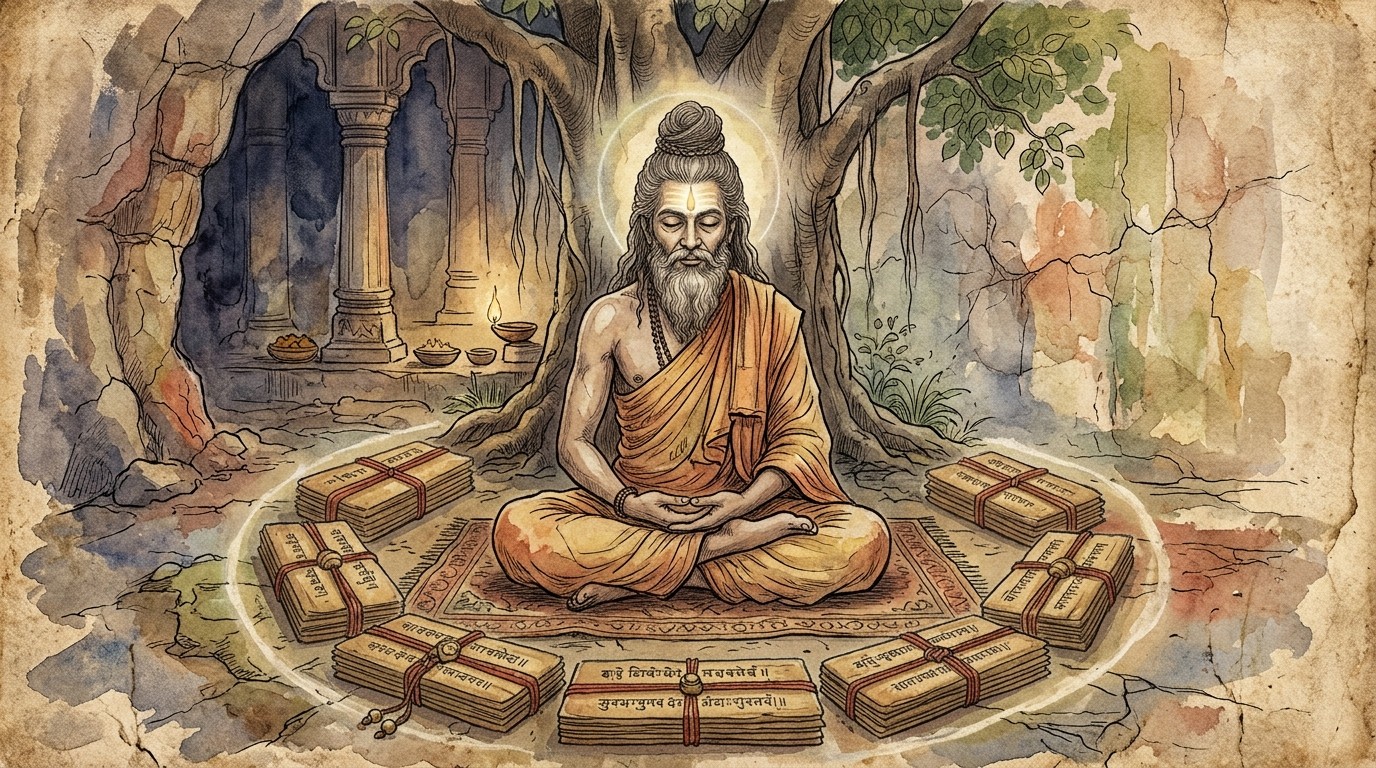
Imagine sitting in a hall while eight people, all at once, ask you to do eight different things.
One asks you to compose a poem — line by line, in a strict metre. Another rings a bell at random moments, and at the end you must say exactly how many times it rang. A third keeps interrupting with unrelated riddles. A fourth quietly changes the subject of your poem halfway through. And while all of this is happening, you hold every single thread in your mind, drop nothing, and at the end recite all eight finished tasks back — perfectly, from memory alone.
No notes. No pauses. Nothing written down.
This is not a stage illusion. It has a name, and it is centuries old. It is called Avadhana — and for generations, it was performed across India by ordinary people who had trained their minds to do something most of us would call impossible.
What is Avadhana?
Avadhana is a classical Indian discipline of attention and memory. In a traditional performance, a single practitioner — called an avadhani — handles many demanding mental tasks at the same time, while a group of questioners deliberately tries to break their concentration.
The word comes from Sanskrit: avadhana, meaning complete, undivided attention.
The scale tells you how serious the tradition was:
Ashtavadhana — eight simultaneous tasks
Shatavadhana — one hundred
Sahasravadhana — one thousand
Read that again. People trained themselves to track a thousand threads at once and recall every one. Not because they were born with rare brains — but because they followed a path.
How was any of this even possible?
This is the part that matters most, so read it slowly: the avadhani was not born this way.
There is a quiet assumption most of us carry — that a sharp memory and deep focus are things you either have or you don't. Avadhana is living proof that this assumption is wrong. These were not magicians or geniuses. They were students of a discipline — one that treated attention and memory not as fixed gifts, but as faculties that could be trained, the way a body can be trained.
And here is where the ancient world and the modern laboratory finally agree. Neuroscience now accepts something the tradition assumed all along: the brain is plastic. Attention can be strengthened. Memory can be conditioned. The pathways you use grow stronger; the ones you neglect fade. The avadhanis simply discovered — long before there was a word for it — how to point that process in one direction, deliberately, every day.
How they did it is the real treasure. And it is exactly what most of the world forgot.
Why was it almost lost?
For most of its history, Avadhana lived mouth to ear — passed from teacher to student, rarely written down as a method anyone could pick up. It belonged to a slower world: long hours, deep quiet, single-pointed attention as a way of life.
Then the world sped up. We handed our memory to our phones. We trained ourselves, without noticing, to switch tasks every few seconds. The very conditions that once produced minds capable of holding a thousand threads were replaced by conditions that struggle to hold one. The art didn't die — but it slipped to the edges, kept alive by a small number of masters while the rest of us forgot it had ever existed.
What does any of this have to do with you?
Everything.
The same faculty the avadhani spent years training is the one quietly slipping in you right now. The forgotten name. The sentence you read three times and still don't recall. The focus that scatters the moment you sit down to think.
You probably blame yourself for it. Most people do. But Avadhana points to a different conclusion — one that is both older and, oddly, more hopeful: your attention and memory are not broken. They are simply untrained. And what can be trained can be rebuilt — not in years of monastic practice, but in a few honest minutes a day, if you know what to practise.
That "what" is the whole game.
Avadhana today
This is not a museum piece. Avadhana is a living art — and in recent years it has been honoured at the very highest national level, a recognition that this tradition never truly disappeared.
What has changed is access. The principles beneath Avadhana — the training of attention, the conditioning of memory, the settling of a restless mind — have, for the first time, been quietly decoded into a form a modern person can actually follow. Not a thousand tasks on a stage. Just the underlying discipline, rebuilt for ten minutes in a busy life.
That decoding is what we built Smriti to be.
Frequently asked questions
Is Avadhana just memory tricks or mnemonics?
No. Mnemonics are clever hacks for a single task. Avadhana is a trained faculty — a conditioned state of attention and recall that holds up across many tasks at once. One is a shortcut; the other is a strengthened mind.
Can anyone learn it, or is it a talent?
The tradition is built on the opposite of talent. Avadhanis are made, not born — through training. The capacity is human, not rare.
Do I have to perform on a stage to benefit?
Not at all. The performance is just the visible proof. The real value is the underlying skill — sharper memory, steadier focus, a calmer mind — and that is what carries into ordinary life.
Smriti — The Avadhana Method takes this ancient discipline and rebuilds it into a guided, modern practice: simple audio sessions, a clear path, ten minutes a day. Not a thousand threads on a stage — just your own memory and focus, finally trained. Explore Smriti →