Mindset
·
3 min read
Ancient Indian Memory Techniques That Actually Work
Mindset
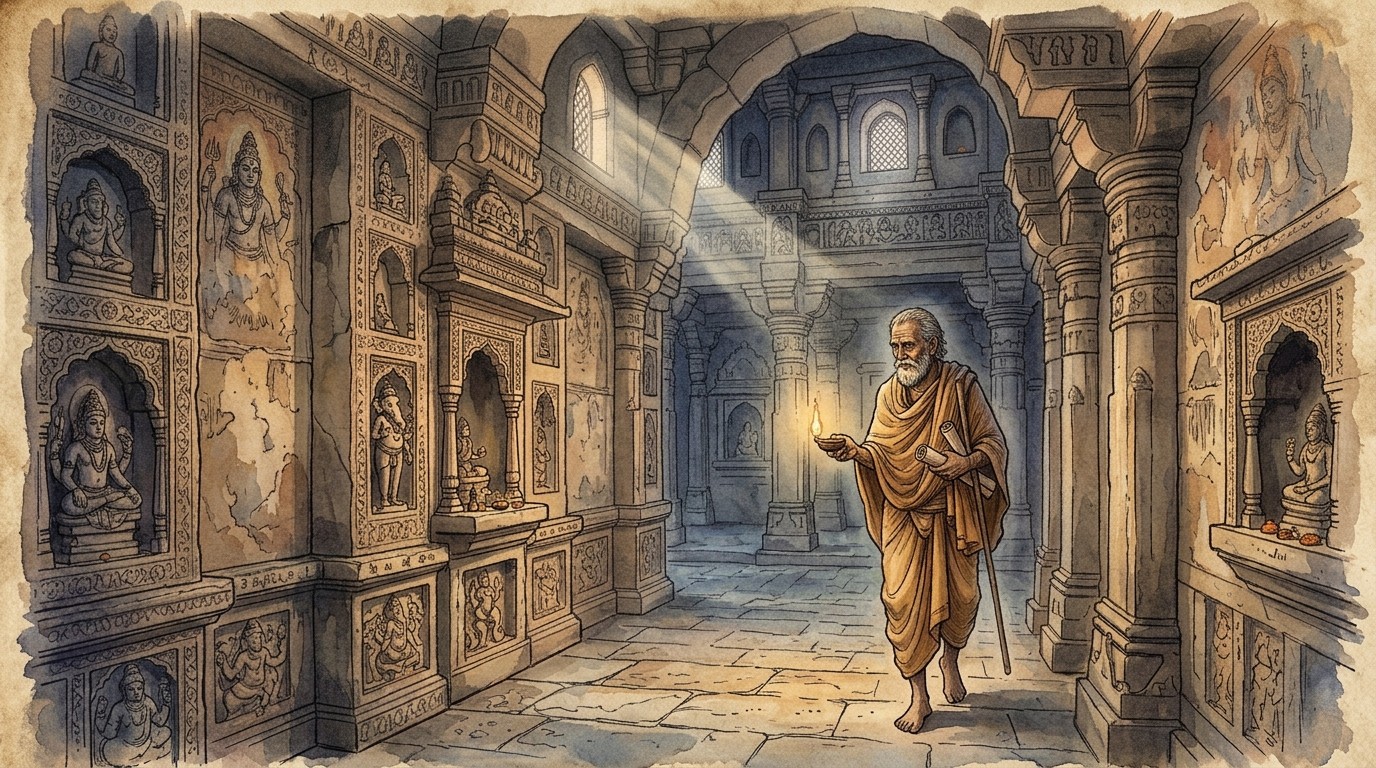
India built a memory technology — thousands of years before the hard drive
Long before books, printing or cloud backups, India faced a serious problem: how do you preserve enormous sacred texts, perfectly, across thousands of years — using nothing but human minds? The answer wasn't to memorise harder. It was an engineering solution — and it worked so well that the oral tradition of the Vedas is considered one of the oldest unbroken oral traditions on earth. UNESCO formally recognised it as a masterpiece of humanity's intangible heritage.
What they invented is genuinely astonishing — and almost nobody outside the tradition knows how it actually worked.
The secret wasn't repetition — it was transformation
Plain repetition is what most of us mean by memorising, and it's fragile. The ancient method did something far cleverer. The same text was recited in multiple patterns, each one rearranging the words in a fixed, almost mathematical order. A few of the stages:
Pada — each word recited separately and cleanly.
Krama — words paired and overlapped: one-two, two-three, three-four, and on.
Jata — words braided forward and backward, again and again.
Ghana — the famous bell pattern, words woven back and forth in an intricate weave, considered the hardest of all.
By forcing the same words through different orders — even backward — the method did two things at once. It burned the text into memory from every possible angle, and it made errors almost impossible to hide. If a single word or accent was wrong, the pattern broke and everyone heard it. It was, in effect, a human error-correcting code, designed thousands of years ago.
Why this still matters for you
Here's the insight modern memory science quietly confirms: you remember what you actively work with, not what you passively repeat. Reorder it, transform it, engage with it from several directions — and it sticks. The ancient pathas were a ruthlessly efficient way of doing exactly that, centuries before anyone measured it in a lab.
And the same principle scaled all the way up to Avadhana, where practitioners held and recalled hundreds of separate threads at once. Different surface, same engine: memory as an active, trained craft — not a passive container you simply hope holds.
The part you can actually use
You don't need to chant the Vedas to benefit. The underlying principle — active transformation over passive repetition — can be rebuilt into a simple daily practice for remembering names, facts, ideas, anything. That principle is the real inheritance. Most modern memory shortcuts miss it entirely.
Smriti — The Avadhana Method takes these time-tested principles and turns them into a guided, modern practice for everyday memory. See what Smriti teaches →