Mindset
·
5 min read
The Legendary Masters of Avadhana
Mindset
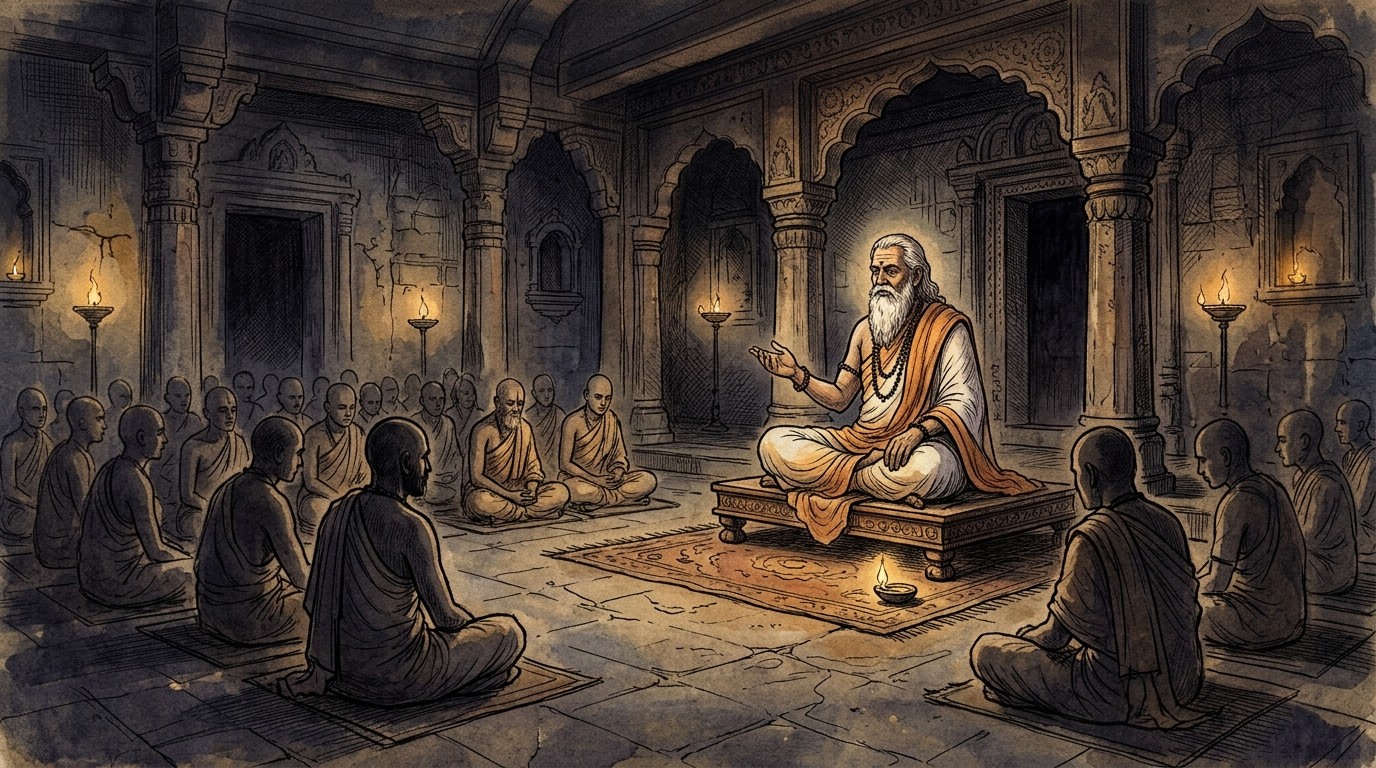
One mind. A thousand questions. No paper.
Picture a single person seated on a stage. In front of them sit eight scholars — sometimes a hundred, in rare cases a thousand. Each one fires a different demand: compose a verse in a fixed metre, but forbidden from using a certain letter; take a deliberately absurd line of poetry and make it make perfect sense; track a bell that rings at random through the entire event and report the exact count at the end. The questions come in rotation, hour after hour. And the performer holds every thread at once — no notes, no pen, nothing but memory and attention.
This is Avadhana — arguably the most demanding test of human focus ever formalised. The word itself means the focusing of the mind. It is not a magic trick. It is a trained skill. And its history is one of the most remarkable — and very nearly lost — stories in Indian intellectual life.
Where it came from
Avadhana grew out of classical Sanskrit literary culture, where composing poetry on the spot under strict rules was the mark of a true scholar. From there it was adopted and developed by Telugu and Kannada poets in medieval times. The earliest hard evidence we have points to around the twelfth century — and from then on, the art flourished in the courts and literary gatherings of southern India.
It also drew remarkable practitioners from the Jain monastic tradition. Jain avadhanis were known to demonstrate the art before emperors: in the Mughal court, one monk is recorded performing more than a hundred simultaneous mental tasks and being honoured by the emperor himself. For centuries, this was how the sharpest minds proved their gift — in public, under pressure, with everything to lose.
The art that almost disappeared
Like many oral disciplines, Avadhana lived only in the minds of its masters. There was no app, no archive — when a generation of practitioners faded, the art faded with them. By the nineteenth century, the living tradition had grown dangerously thin. It came close to vanishing entirely.
The duo who brought it back
Its revival owes an enormous debt to two men who worked as one: Divakarla Tirupati Sastry (1872–1919) and Chellapilla Venkata Sastry (1870–1950), the cousin-poets remembered together as Tirupati Venkata Kavulu.
In the late nineteenth and early twentieth centuries, they travelled across the Telugu country performing Avadhana as a pair — one picking up where the other left off, complementing each other so seamlessly that audiences felt they were watching a single mind operating through two bodies. With ready wit and astonishing command of metre, they could hold a hall spellbound for hours, fielding any puzzle or constraint thrown at them.
What made them historic was not only their skill but their reach. They took classical metrical verse out of the closed world of scholars and carried it to ordinary audiences, dramatising the great epics into popular plays. And they mentored a generation of poets who would go on to shape modern literature — including Viswanatha Satyanarayana, a future Jnanpith laureate. By the time they were done, Avadhana was alive again. Today they are remembered as the harbingers of modern Telugu poetry.
Still alive today
The tradition they rescued is, against all odds, still being performed — and still being honoured at the highest levels of the country:
Garikapati Narasimha Rao, known as a Maha Sahasravadhani, faced an extraordinary 1,116 questioners over 21 days in Kakinada in 1996. He received the Padma Shri in 2022.
Medasani Mohan is celebrated for marathon performances — including being the first to attempt a pancha-sahasra avadhanam, with a staggering five thousand questioners.
Vaddiparti Padmakar is known as a Tribhasha avadhani, performing simultaneously across three languages — Telugu, Sanskrit and Hindi.
Shatavadhani R. Ganesh is credited with almost single-handedly reviving the art in Kannada, which had no living practitioner when he began. In 2026 he was awarded the Padma Bhushan — a measure of how seriously the nation still regards this living tradition.
And the art is no longer the closed circle it once was. Long dominated by men, Avadhana now counts women among its accomplished performers — a quiet but significant shift for a discipline this old.
What these masters actually prove
Here is the part that matters for the rest of us. None of these performers were born with a different kind of brain. They took the same human memory and attention you and I carry around — and trained it, through specific and repeatable disciplines, to an extreme almost no one believes is possible.
Now hold that against where most of us are. We struggle to stay with a single task for five minutes before reaching for a phone. We read a page and remember nothing of it. That contrast isn't a verdict on our intelligence — it's a verdict on what we have simply stopped training. Avadhana is living proof of how far focused attention and memory can be developed when you work at them on purpose.
A modern doorway into an ancient skill
We'll be honest: we don't teach the full competitive art of Avadhana — very few alive can. Smriti is our modern interpretation of this tradition. We've taken the underlying principles of memory and attention that sit beneath it, and rebuilt them in plain, modern language — for ordinary people who just want to focus deeply and remember what matters again.